Riding in Japan
Left-hand traffic, low limits and tolled expressways. Once you adjust, Japan is one of the easiest countries to ride.
First time driving in Japan?
Please take a look at the safety driving leaflet produced by Japan's National Police Agency. Two illustrated pages covering license requirements, the fundamental rules, and the accidents visiting drivers most often have. Everything on this page follows it.
Open or download the PDF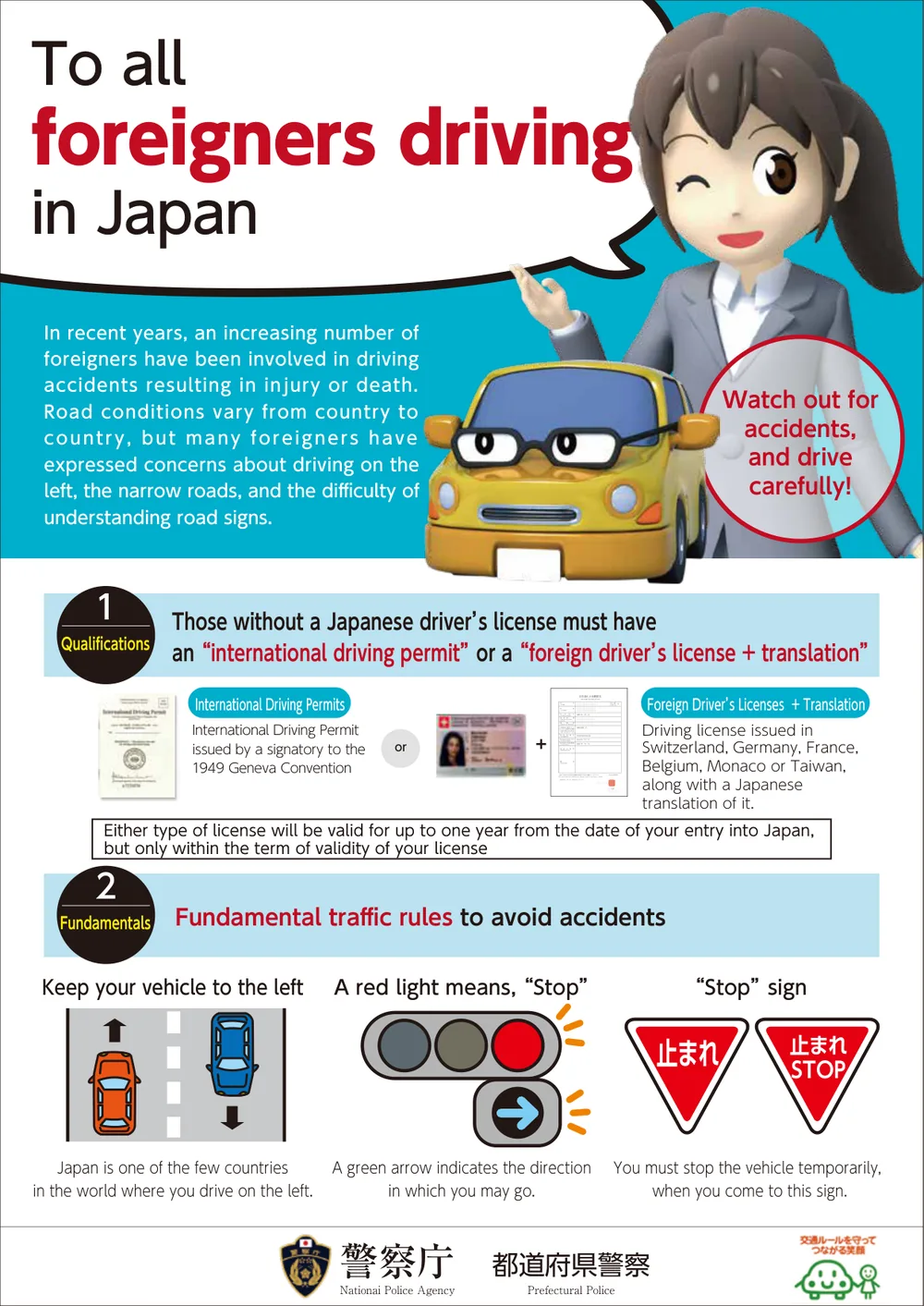
1 / 2
Are you qualified to ride in Japan?
If you do not hold a Japanese driver's license, you need one of the following. Without it we cannot hand over the motorcycle.
International Driving Permit
An International Driving Permit issued by a signatory to the 1949 Geneva Convention. Permits issued under any other convention are not valid in Japan.
Get it in your own country before you fly — it cannot be issued in Japan.Foreign license + Japanese translation
Only for licenses issued in Switzerland, Germany, France, Belgium, Monaco or Taiwan, accompanied by an official Japanese translation of that license.
How long it is valid for
You can ride in Japan for up to one year from the date you entered Japan, and only while your International Driving Permit (or equivalent) is valid.
On the day, be sure to bring your International Driving Permit (or Japanese translation), your national driving licence and your passport.Source: National Police Agency, "To all foreigners driving in Japan" leaflet.
Common mistakes for visiting riders
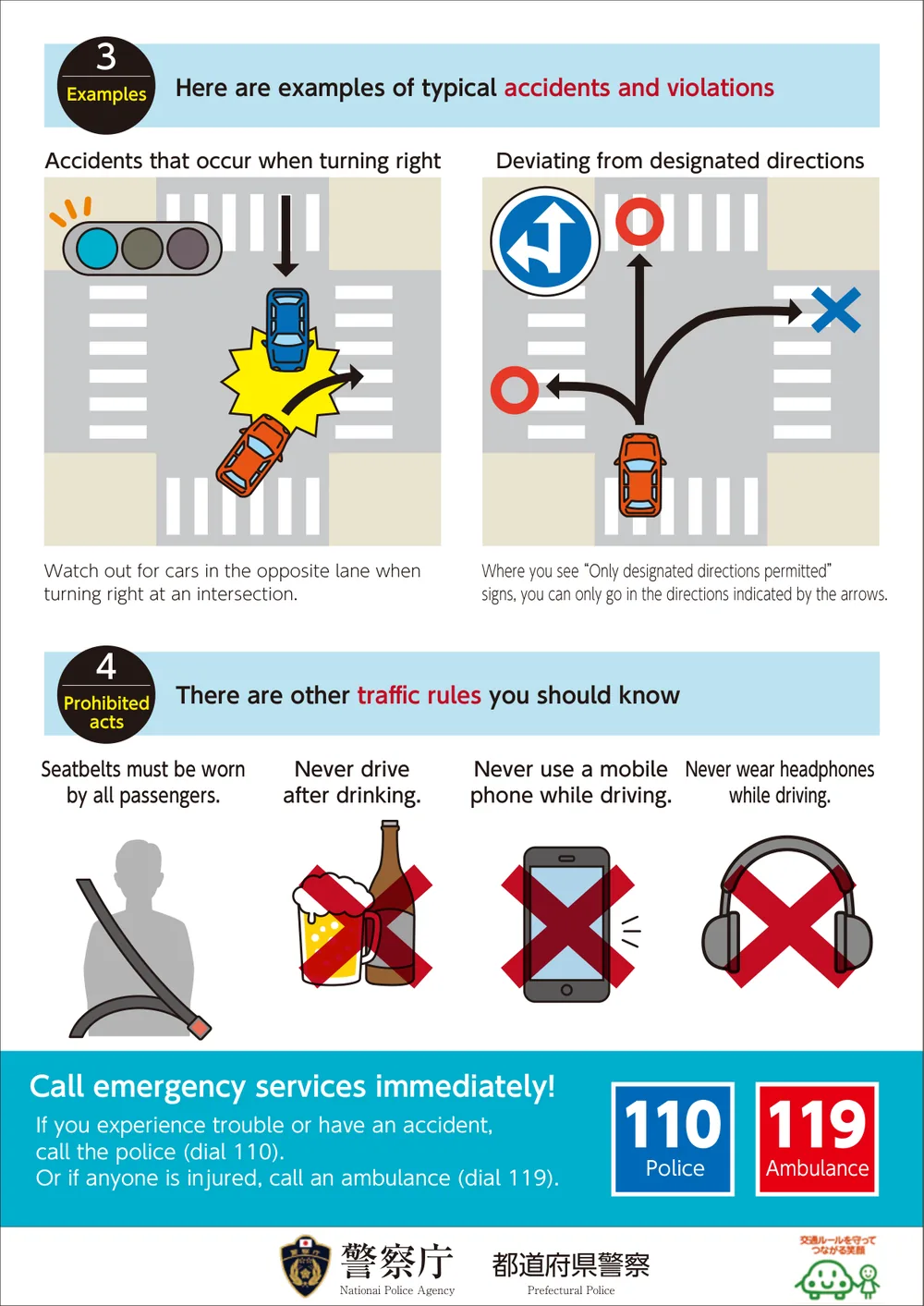
The two examples the National Police Agency singles out for foreign drivers.
Turning right across traffic
Watch for oncoming traffic when turning right at an intersection. In left-hand traffic a right turn crosses the opposing lane — the exact manoeuvre that catches out riders from right-hand-drive countries.
Ignoring designated-direction signs
Where a "designated directions only" sign is posted, you may travel only in the directions shown by the arrows — even if going straight on looks perfectly possible.
If you have an accident or trouble
Police
If you have an accident, help anyone who is injured and make the scene safe, then call the police on 110.
A Traffic Accident Certificate is required for any insurance claim.
Ambulance
If anyone is injured, call an ambulance on 119.
Contact us
Once you have done what is needed, such as reporting to the police, be sure to contact us.
Contact form →
Closed: Tuesdays, Wednesdays and the 2nd Saturday of the month
Roadside assistance (Tokio Marine & Nichido)
Every motorcycle comes with roadside assistance through its insurance. If an accident or breakdown leaves you unable to ride, call the dedicated accident and roadside line on 0120-119-110 (toll-free, foreign-language support through an interpreter).
Any costs beyond what the roadside assistance covers are charged to you. Coverage →
Expressway tolls
Every expressway in Japan is tolled, and charged by the distance you travel.
| ETC (recommended) | Our machines have an ETC unit fitted. We lend the card free of charge and bill only the actual tolls when you return — you ride straight through without stopping. |
|---|
Official resources
Produced by Japan's National Police Agency for visiting drivers and riders. Have a look before you book.
Safe driving leaflet (PDF)
The source for everything on this page — license requirements, the basic rules and typical accidents, explained with diagrams.
警察庁 / National Police AgencyVideo — turning at intersections
The official video explaining how to turn right and left. Worth watching if you have never ridden in left-hand traffic.
警察庁 / National Police AgencyOur own rider guide
What to bring, what happens on the day, and how the return works. Read it before you book.
Kyoto Bike TravelOn the road
Ask for "hi-oku" at the pump
All our machines take high-octane fuel — the yellow nozzle at a self-service pump, or say "hi-oku mantan" to an attendant. In rural areas many stations close at night and on Sundays, so fill up earlier than you think you need to.
Motorcycle parking is restricted
A motorcycle often cannot use either a bicycle rack or a car park. At tourist sites you need to find motorcycle-specific parking, and street parking is enforced against. Any fine incurred is charged in full to the rider.
The rainy season, typhoons and snow
June is generally the rainy season, and typhoons are possible from August into October. From December to March, mountain passes may be impassable due to snow and ice.
Helmet required, armour recommended
A helmet is a legal requirement. Helmet rental is available, subject to stock.
From one of our riders
Mark MillerChicago, USA / First motorcycle trip to Japan
“Advice For Renting A Motorcycle In Japan” by Mark Miller